Michela Taufer
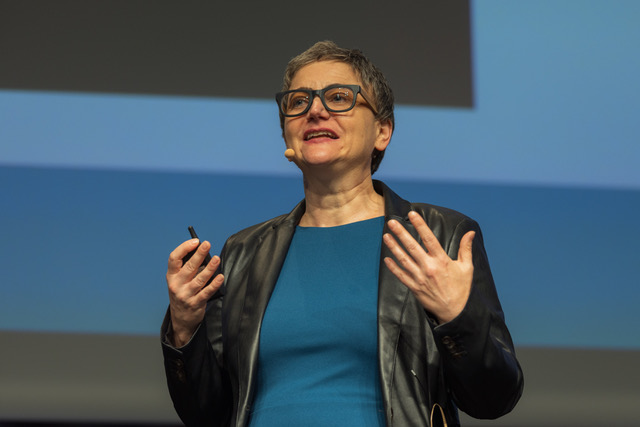
Designing for Trust, Transparency, and Efficiency in Scientific Computing
Michela Taufer, an AAAS Fellow and ACM Distinguished Scientist, is the MathWorks Professor at the University of Tennessee, Knoxville.
Scientific computing is entering a regime where nondeterminism, opaque AI decisions, and energy costs are no longer edge cases—they define everyday practice at scale. In this keynote, I will present practical methods that make modern scientific workflows more trustworthy, transparent, and efficient. I will demonstrate how graph-based analysis can pinpoint the sources of nondeterminism in large HPC simulations; how fine-grained provenance can make AI-driven workflows auditable and easier to explain; and how predictive engines can avoid redundant computation in neural architecture search, cutting both runtime and energy. I will conclude with a broader vision: scientific ecosystems that intentionally couple data, experiments, and computation—so results are not only faster, but also reproducible, explainable, and ready for reliable reuse.
Anne-Marie Kermarrec

Decentralized Learning at the Edge: Unlocking the Future of AI
Anne-Marie Kermarrec, Full Professor at EPFL, Lausanne, Switzerland
As concerns around data privacy grow, decentralized learning enables collaborative model training without sharing raw data. Yet, exchanging model updates can still leak sensitive information, and system performance is often hindered by stragglers in heterogeneous environments.
In this talk, I will highlight these key challenges and present recent advances in straggler-resilient learning and privacy-preserving protocols. Together, these results pave the way for decentralized learning systems that are both efficient and secure, enabling scalable AI at the edge.
Luca Benini

Sustainable, Pervasive Agentic AI - Nowhere to go, but UP!
Luca Benini holds the chair of digital Circuits and systems at ETHZ and is Full Professor at the Università di Bologna.
Computing is now dominated by generative AI, with focus rapidly shifting from training to (agentic) inference. The fast pace imposed by generative AI scaling laws requires sustained energy efficiency improvements, which cannot be matched simply by classical (Moore’s Law) technology evolution. We must move toward full three-dimensional scaling: UP, in stacking and in scale, is the only way to go. To tackle the challenge, we need to aggressively optimize computing platforms leveraging specialization. However, the design of scalable domain-specific 3D architectures requires actionable understanding of Amdahl’s, Patterson’s, and Little’s laws. In this talk, I will show how to leverage these fundamental laws in computer engineering to design the next generation of AI chips and systems.
Supported By
Gold Sponsors


Silver Sponsors



Organized By
Proceedings Support